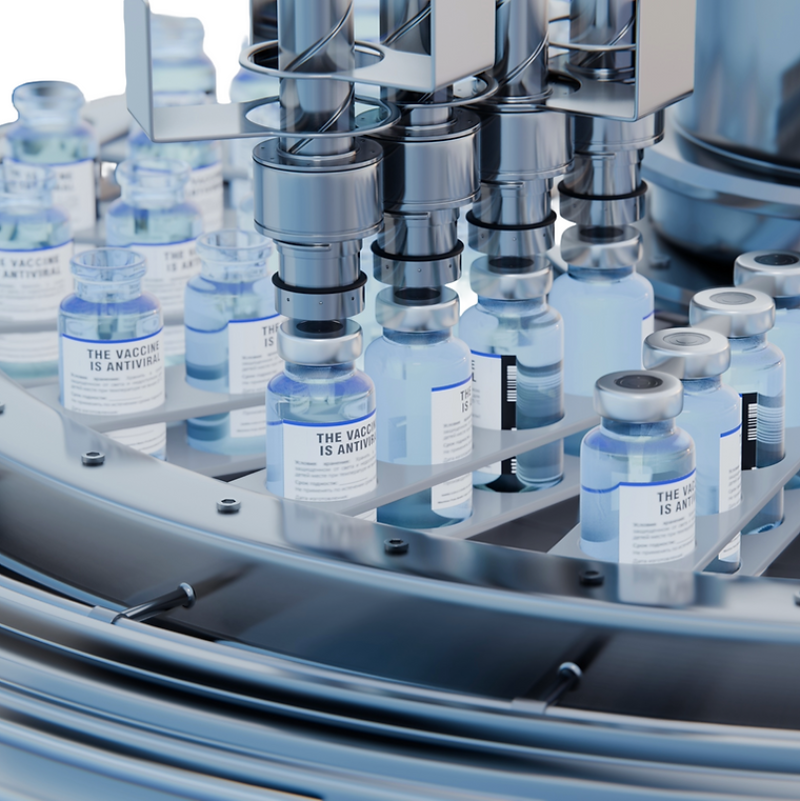
The medical sector encompasses a broad ecosystem including medical device manufacturers, pharmaceutical companies, biotechnology firms, and healthcare providers. Each component of this ecosystem demands consistent operational accuracy and sustainable quality across all production stages.
Medical manufacturing processes are strictly governed by international regulations and quality standards. Certifications such as ISO 13485, GMP, and CE impose rigorous requirements not only on products but also on the machinery involved in production. Auxiliary machines must therefore comply with validation, documentation, and traceability expectations.
Most medical products require tolerances at micron levels. This necessitates auxiliary machinery capable of delivering exceptional repeatability, vibration control, and process stability to maintain consistent product quality.
Auxiliary machinery supports the efficient and safe operation of primary production equipment. In the medical sector, these systems are essential components that ensure continuity and reliability in manufacturing processes.
Well-engineered auxiliary machines significantly reduce the risk of human error on production lines. Automated feeding, handling, and positioning systems minimize product contact and enhance hygiene standards.
Downtime in medical manufacturing results in substantial operational costs. Auxiliary machinery optimizes process flow, ensuring uninterrupted production and improved capacity utilization while shortening lead times.
Our company goes beyond the traditional role of a machinery supplier. With a project-based engineering mindset, we analyze the entire operational workflow and design customized systems tailored to specific requirements.
From initial design to commissioning, all stages are managed by multidisciplinary engineering teams. Mechanical design, automation software, and process integration are treated as a unified system rather than isolated components.
Considering evolving product portfolios and increasing capacity demands in the medical sector, our auxiliary machines are developed with modular architectures. This approach ensures long-term investment security and adaptability.
Advanced technologies are seamlessly integrated into our solutions for the medical sector. Digitalization and automation form the foundation of system performance and reliability.
Sensor-based control mechanisms and data acquisition infrastructures enable real-time monitoring of production processes. This allows early detection of quality deviations and proactive intervention.
Collected production data is actively utilized for continuous process improvement. This methodology ensures consistency, standardization, and operational excellence in medical manufacturing.
Beyond product safety, the medical sector places increasing emphasis on environmental responsibility. Energy-efficient and durable auxiliary machinery plays a vital role in sustainable manufacturing strategies.
Our systems are designed to minimize energy consumption by reducing unnecessary movements and idle times. This results in more efficient use of resources without compromising performance.
Robust material selection and maintenance-friendly designs ensure stable machine performance over extended periods. This significantly reduces total cost of ownership and enhances operational confidence.
Rapid advancements in healthcare technologies are driving continuous transformation in medical manufacturing infrastructures. Personalized medical products and small-batch production models increase the demand for flexible and intelligent auxiliary machinery.
Future medical production facilities require systems capable of adapting quickly to product changes. Auxiliary machinery with high flexibility provides a critical competitive advantage.
Solutions developed in line with Industry 4.0 principles elevate transparency and traceability in the medical sector to unprecedented levels.
Our company addresses today’s medical sector requirements while anticipating future production challenges through a forward-looking engineering vision. By delivering auxiliary machinery solutions aligned with the core values of trust, quality, and sustainability, we aim to establish long-term partnerships within the healthcare industry.