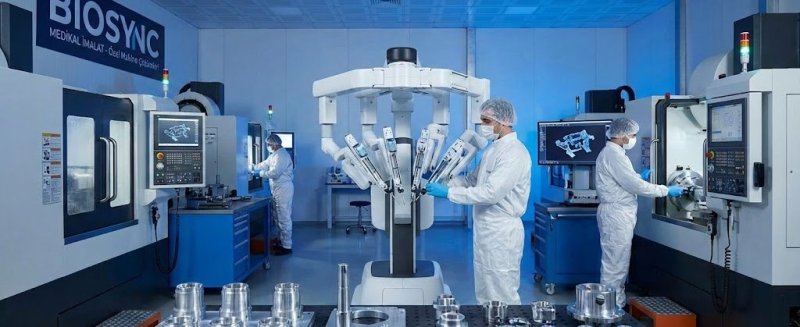
Medical custom machine manufacturing is essential because precision, sterility and repeatability directly affect patient safety, treatment efficiency and clinical product reliability. Properly engineered systems ensure consistent output quality, accelerated production cycles and full compliance with international medical device regulations.
Data collected from manufacturing facilities adopting automated medical machinery show up to a 30–40% improvement in quality consistency and significant reductions in cycle times. These measurable gains demonstrate the strategic value of custom-engineered medical equipment.
The development of medical machinery depends on advanced components engineered to operate under strict cleanliness and accuracy requirements.
- High-resolution servo axes
- Non-contact sensing systems
- Validation-ready control software
- Biocompatible material processing units
- Machine vision inspection modules
These modules create highly stable and reliable medical production platforms.
Clinical purpose, material characteristics and production throughput are assessed.
Each subsystem must be traceable, verifiable and compliant.
Virtual modeling ensures module compatibility.
Verification is performed under ISO 14971 and ISO 13485 frameworks.
Medical custom machine manufacturing incorporates motion control technologies, smart sensors, adaptive automation, AI-supported inspection mechanisms, advanced sterilization systems and real-time data logging platforms. These systems offer the highest possible stability through closed-loop feedback mechanisms.
Recent studies highlight that machine vision solutions used in medical equipment manufacturing achieve accuracy rates close to 97%, reducing defect-related failures by approximately 40%.
PLC platforms, real-time data tracking and structured control algorithms improve auditability and reduce operational variability. Software modules typically follow GAMP 5 compliance for regulated environments.
Cleanroom-compatible designs allow consistent operation without contamination risks. Biocompatible polymers, titanium, stainless steel and composite materials demand precise thermal and mechanical processing conditions.
- High-resolution imaging sensors
- AI-based defect detection
- Dimensional validation
- Automated surface scanning
These technologies guarantee consistent output quality even under high cycle volumes.
Medical custom machines are widely used in surgical instrument manufacturing, implant production, sterile packaging, pharmaceutical filling lines, hematology systems and diagnostic automation.
Micron-level tolerances require multi-axis motion control and laser-based processing. Integrated biomechanical test modules help verify fatigue strength and structural stability.
The precision of filling systems depends on viscosity measurement, flow regulation and particulate monitoring. Contemporary systems achieve extremely low contamination rates and support controlled environments at ISO Class 5–7.
- Automated pipetting
- Sample preparation modules
- Reagent dispensing
- Barcode-based traceability
These tools ensure reliable clinical decision-making by improving data accuracy.
Decision-making in medical machine engineering is driven by risk management, process complexity, regulatory impact levels and long-term operational goals. Feasibility analyses incorporate component reliability metrics, energy consumption, validation workload and future scalability.
Digital twins and predictive modeling approaches help manufacturers reduce error margins and accelerate development cycles. Statistical reviews show a 20–25% increase in design accuracy when simulation-based decision tools are integrated into early planning.
- V-model validation
- Risk-oriented process planning
- Structured test documentation
- Requirements traceability
These frameworks ensure each engineering step complies with medical device quality standards.
Functional analysis, environmental resistance tests and clinical-grade sterilization validations are conducted prior to commissioning. Sampling strategies follow regulated statistical thresholds to ensure reliability.