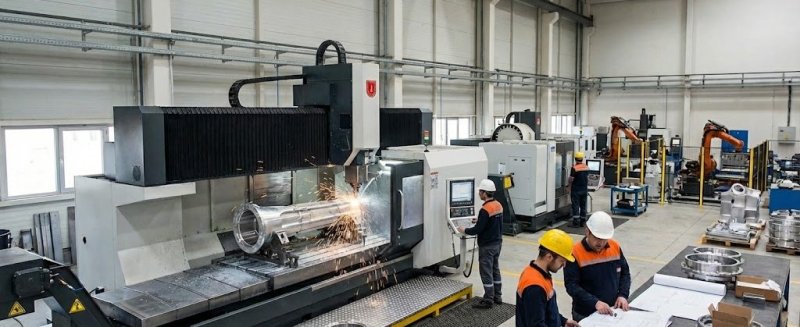
Special machine manufacturing for the defense industry is an engineering-intensive production discipline focused on creating highly precise systems used for military and security applications. These machines are designed beyond standard industrial tolerances and integrate multi-axis machining, advanced alloys, ballistic-resistant materials and cyber-physical production processes. Their primary purpose is to ensure reliable, durable and mission-critical performance under extreme operational conditions.
The defense sector’s strict verification and traceability requirements distinguish this manufacturing field from others. Every engineering stage is controlled through international military standards, accreditation rules and robust validation protocols. As a result, each machine becomes a strategic asset rather than a simple production device.
Special machines are essential because military systems require micro-level accuracy, structural durability and long-term operational consistency. Standard industrial equipment cannot meet these strict expectations. Approximately 60% of modern defense platforms are manufactured using custom-designed machines and intelligent production systems, demonstrating the strategic importance of dedicated machine technologies.
Additionally, reducing foreign dependency in defense supply chains makes special machine manufacturing a key element of national resilience. Countries investing in indigenous production infrastructure significantly enhance their strategic autonomy.
Defense manufacturing incorporates several categories of purpose-built machines, each engineered to support specific production cycles.
Used for barrels, missile bodies, optical housings, UAV components and armored vehicle parts. These systems often reach tolerances of 0.002 mm.
Machines combining additive manufacturing and subtractive machining enable rapid prototyping and production of high-strength metal components, including titanium and Inconel alloys.
Ballistic testing devices, vibration platforms and environmental stress chambers simulate mission conditions to validate equipment reliability.
Automated fiber placement systems, high-pressure presses and controlled curing ovens are essential for modern lightweight armor and composite structures.
Robotic cells and automated placement systems handle carbon-based materials and aerodynamic structures with high repeatability.
Defense-grade machine manufacturing relies on materials that exhibit superior strength, heat tolerance and long-term stability.
• Maraging steels
• Nickel-based superalloys
• Titanium varieties
Used for aerospace and missile applications requiring strength-to-weight optimization.
• Kevlar derivatives
• UHMWPE
• Ceramic composite armor
Known for exceptional energy absorption characteristics.
Critical in hypersonic systems operating above 1000°C.
The development workflow is built around mission requirements, safety constraints and detailed traceability. Unlike conventional machinery, each design integrates security systems, controlled access features and digital protection layers while ensuring compatibility with military duty cycles.
A typical development flow includes:
- Requirement analysis
- Mission profile integration
- Concept formulation
- Material selection & structural analysis
- Prototyping
- Military-grade validation
- Production integration
Every step is documented to comply with defense procurement regulations.