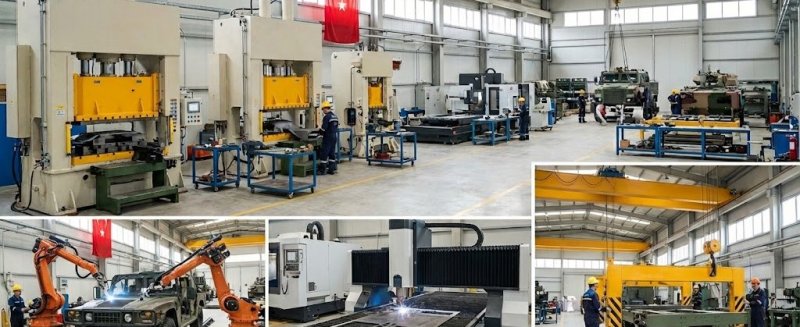
Defense production environments require meticulous spatial planning to ensure that each auxiliary machine supports a defined operational cluster. Precision machining lines rely on calibration units; missile assembly processes require multi-axis test systems; radar manufacturing cells integrate thermal and humidity testing machines. Each auxiliary system contributes to a controlled engineering flow where cycle time, dimensional integrity and risk mitigation are balanced.
In modern defense manufacturing, nearly 80% of operations depend on synchronized automation layers. Auxiliary machines serve as buffers, coordination nodes and quality gates that prevent production downtime. This synchronization is essential in aircraft structures, unmanned systems, armored platforms and RF-based technologies, where continuity and measurement repeatability define long-term performance stability.
Defense industry auxiliary machines can be grouped into production support, testing and certification, surface preparation, energy stabilization and internal logistics categories. Each category fulfills a specialized engineering requirement and contributes uniquely to the overall technological ecosystem.
Production support machines reinforce accuracy, repeatability and material consistency across demanding manufacturing cycles. High-pressure compressors, industrial calibration stations, automated measurement systems, and material-forming presses are among the foundational elements of this category.
Calibration units maintain long-term accuracy in CNC machines by compensating for thermal drift, mechanical wear and micro-alignment deviations. These units are vital for producing missile casings, transmission housings, radar array components and high-strength structural elements where tolerances frequently fall below 10 microns.
Compressed-air infrastructures power fastening tools and pneumatic automation modules across more than 70% of defense assembly facilities. Stable pressure profiles ensure consistent torque outputs and predictable assembly line performance, preventing quality fluctuations.
Defense components must endure stress conditions far beyond civilian manufacturing standards. Testing machines replicate operational environments, enabling engineers to validate durability, temperature resilience and vibration resistance before deployment.
Missile guidance modules, aircraft avionics, naval electronics and armored vehicle subsystems must withstand intense vibration loads. Modern vibration tables operate with resolutions around 0.1 g, simulating high-frequency profiles encountered during launch, recoil or high-speed maneuvers.
Many defense electronics must operate reliably between –40°C and +70°C. Thermal shock chambers provide rapid cycling to assess material fatigue, solder joint durability and system endurance. These chambers are especially vital for radar modules, EO/IR sensors and tactical communication platforms.
Surface integrity strongly influences the durability and operational lifespan of defense products. Machines in this segment prepare metals, composites and hybrid materials for coating, bonding or assembly.
Shot peening increases fatigue resistance and reduces surface stress concentrations by up to 15%. Defense materials such as armor steel, titanium alloys and high-performance composites benefit significantly from uniform surface compression.
Surface finishing systems must comply with military standards such as MIL-DTL-53039. Auxiliary coating machines ensure controlled film thickness, improved corrosion protection and optimized adhesion properties on platforms ranging from armored vehicles to missile launch tubes.
Energy stability is essential in large defense production facilities. Even millisecond-scale voltage fluctuations can compromise high-precision calibration processes.
UPS systems designed for defense environments provide instantaneous switching responses, protecting sensitive machines from instability, voltage sags and transient failures that could lead to measurement drift or operational halts.
Defense manufacturing requires controlled movement of sensitive components, many of which are vulnerable to vibration, static charges or impact damage.
Autonomous mobile robots equipped with lidar or magnetic navigation improve internal logistics efficiency by up to 25%. Their consistent routing and load stability contribute to safer and more predictable operations.
Selecting auxiliary machines requires evaluation across precision, longevity, system compatibility and environmental robustness. Defense projects demand consistent accuracy over long production cycles without tolerance drift.
Manufacturing tolerances in defense components often reach ±0.005 mm. For this reason, auxiliary machines must provide stable sensor accuracy, precise calibration cycles and repeatability above 98%. Any deviation risks failures in critical systems such as propulsion modules or encrypted communication hardware.
Auxiliary machines should support a wide variety of specialized materials, including titanium alloys, ballistic-grade steel, carbon fiber, high-temperature composites and sensitive electronic substrates. Machines must accommodate different coefficients of thermal expansion, machining behaviors and chemical resistance profiles.
Defense factories operate through interconnected PLC, SCADA and MES frameworks. Auxiliary machines must communicate seamlessly using industrial protocols such as Profinet, EtherCAT or CANbus. Integration determines whether machines enhance or hinder digital manufacturing ecosystems.
Operational studies show that neglected auxiliary machine maintenance can increase annual production losses by up to 8%. Therefore, machines with predictable maintenance patterns, accessible components and diagnostic features are essential for stable long-term deployment.
The following table summarizes functional distinctions among widely used auxiliary machine types in the defense industry. The table excludes pricing information.